
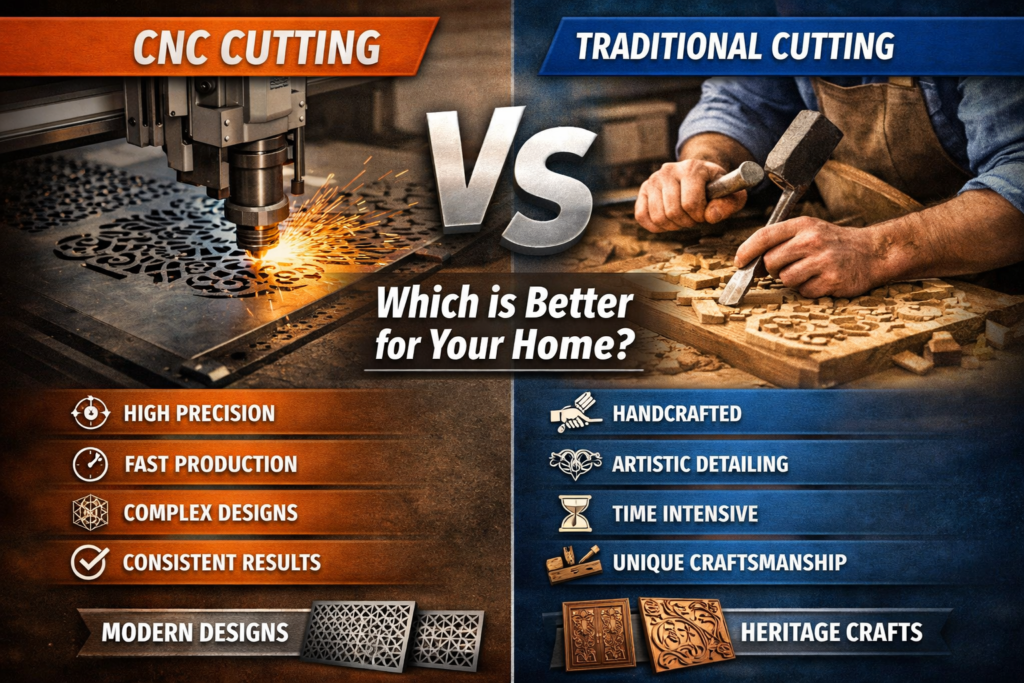
- What is CNC cutting?
- What is traditional cutting?
- Why CNC Cutting Is Becoming Popular in 2026
- Design Flexibility: CNC Offers Unlimited Creativity
- Speed and Efficiency Comparison
- Cost Comparison: Which is More Affordable?
- Quality and Consistency
- Material Compatibility
- Best Home Uses for CNC Cutting
- Advantages of Traditional Cutting
- Why CNC Cutting is the Future of Home Design
- Tips for Choosing the Right Cutting Method for Your Home
- Conclusion
- Frequently Asked Questions (FAQs)
Home design and interior decoration have undergone a tremendous transformation over the past ten years. From modern wall art to stylish partitions and decorative panels, today’s homeowners seek designs that are precise, beautiful, and durable. One of the biggest questions people ask when planning interiors is: should they choose CNC cutting or traditional cutting techniques?
In 2026, CNC cutting technology is transforming home design, especially in areas like wall art, lattice panels, balcony railings, partitions, gates, and interior decor elements. On the other hand, traditional cutting methods still hold their place in craftsmanship and handmade art.
But which one is better for your home?
In this detailed guide, we’ll compare CNC cutting versus traditional cutting in terms of precision, cost, design flexibility, durability, speed, and overall value. By the end of this article, you’ll have a clear understanding of which option is best for your home in 2026.
What is CNC cutting?
CNC cutting (Computer Numerical Control Cutting) is an advanced manufacturing process that uses computer-controlled machines to cut materials with extreme precision. These machines follow a digital design file and make highly precise cuts in:
• Metal
• Wood
• Acrylic
• MDF
• PVC
• Stone
CNC machines are widely used in modern architecture and interior design because they allow for the creation of intricate decorative patterns and detailed designs that are difficult to create by hand.
Common CNC Applications in Home Design
CNC cutting is widely used in modern homes for:
• Decorative wall art
• Laser-cut lattice panels
• Room partitions
• Decorative gates
• False ceiling panels
• Backlit wall decor
• Modern geometric wall designs The biggest advantage of CNC cutting is its precision and repeatability. Once a design is digitally created, it can be created perfectly every time.
What is traditional cutting?
Traditional cutting refers to hand-cutting methods performed by skilled craftsmen using tools such as:
• Hand saws
• Metal cutting tools
• Chisels
• Hand grinding machines
• Hand-carving tools
These techniques rely heavily on human skill, experience, and craftsmanship. Traditional cutting has been used for centuries to create furniture, sculptures, wood carvings, and architectural details.
Common Traditional Uses in Homes
Traditional cutting is commonly used for:
• Hand-carved wooden furniture
• Carved wooden doors
• Stone sculptures
• Decorative carvings
• Custom hand-made designs While traditional methods produce beautiful workmanship, they typically require more time and effort than CNC cutting.
Why CNC Cutting Is Becoming Popular in 2026
As technology advances, more and more homeowners and interior designers are switching to CNC cutting for modern home designs. There are several reasons why CNC technology is dominating the home decor market.
1. Perfect Precision
The biggest advantage of CNC cutting is its high accuracy.
Traditional cutting relies on human skill, which can lead to minor variations. However, CNC machines follow digital blueprints, allowing them to create designs with millimeter-level precision.
This is especially important for:
• Intricate lattice patterns
• Geometric wall art
• Decorative panels
• Symmetrical designs In modern interiors, where clean lines and symmetry are crucial, CNC cutting performs far better than manual techniques.
Design Flexibility: CNC Offers Unlimited Creativity
When it comes to design possibilities, CNC cutting completely changes the game.
Using traditional methods, creating highly detailed patterns can be difficult and time-consuming. But with CNC cutting, designers can create intricate digital designs that are easily cut by machines.
Examples of Creative CNC Designs
• Floral Wall Panels
• Islamic Geometric Patterns
• Mandala Designs
• Modern Abstract Wall Art
• Nature-Inspired Metal Panels
• Decorative Partitions In 2026, homeowners prefer customized interior decor, and CNC cutting makes customization easy.
Speed and Efficiency Comparison
Another major difference between CNC cutting and traditional cutting is production speed.
Traditional Cutting
Hand-cutting can take hours or even days, depending on the complexity of the design. Skilled craftsmen must measure, mark, and carefully cut each part.
CNC Cutting
CNC machines operate automatically and can complete the same task in much less time. Once the design is programmed, the machine operates at a constant high speed.
This makes CNC cutting ideal for:
• Large projects
• Bulk production
• Commercial interior work
• Rapid home renovations For homeowners who want quick installation without compromising on design, CNC cutting is a clear winner.
Cost Comparison: Which is More Affordable?
Many people assume CNC cutting is expensive because it uses advanced machines. However, the cost comparison is more interesting than it seems.
Traditional Cutting Costs
Traditional cutting requires skilled labor and more time, which increases overall cost for complex designs.
CNC Cutting Costs
CNC cutting reduces labor and speeds up production, making it more cost-efficient for detailed designs and larger projects.
However, for very small or simple cuts, traditional methods may still be cheaper.
Cost Summary
| Factor | CNC Cutting | Traditional Cutting |
| Complex Designs | More Affordable | Expensive |
| Simple Designs | Moderate | Cheaper |
| Large Projects | Very Cost Efficient | Costly |
| Custom Designs | Excellent Value | Time Consuming |
Overall, CNC cutting provides better value for modern home décor projects.
Quality and Consistency
Consistency is where CNC cutting truly shines.
With traditional cutting, each piece is slightly different because it relies on human skill. While this can add charm to handmade pieces, it’s not ideal when you want perfectly matching panels or a symmetrical design.
CNC cutting ensures:
• Consistent design
• Perfect repeatability
• Smooth edges
• Professional finish This is especially important for projects like wall panels, partitions, railings, and decorative screens.
Material Compatibility
CNC machines can work with a wide variety of materials used in modern homes.
Materials Compatible with CNC Cutting
• Stainless Steel
• Mild Steel
• Aluminum
• Wood
• MDF
• Acrylic
• PVC Board
• Stone
Traditional cutting is often limited by available tools and artisan skills. In 2026, homeowners will prefer mixed-material interior designs, making CNC cutting more versatile.
Best Home Uses for CNC Cutting
CNC cutting is ideal for many modern home design elements.
1. Decorative Wall Art
Metal wall art and laser-cut panels are used to create statement walls in modern homes.
2. Lattice Panels
CNC lattice designs are popular for:
• Balcony railings
• Room partitions
• Exteriors
3. Room Dividers
Laser-cut partitions provide privacy while maintaining an open space.
4. Backlit Wall Designs
CNC-cut panels, combined with LED lighting, create stunning backlit wall decor.
5. Modern Gates and Railings Intricate metal designs give homes a luxurious and modern look.
Advantages of Traditional Cutting
Even though CNC technology dominates modern construction, traditional cutting still has some benefits.
Handcrafted Artistic Value
Handmade designs carry a unique charm and cultural value. Many luxury homes still use hand-carved wooden elements for traditional aesthetics.
Customization by Skilled Craftsmen
Experienced artisans can modify designs manually while working, something machines cannot easily do.
Ideal for Antique and Heritage Designs
Traditional cutting is often preferred for restoration projects and heritage-style architecture.
CNC Cutting vs Traditional Cutting: Quick Comparison
| Feature | CNC Cutting | Traditional Cutting |
| Precision | Extremely High | Moderate |
| Speed | Very Fast | Slow |
| Design Complexity | Unlimited | Limited |
| Consistency | Perfect | Varies |
| Cost for Large Projects | Lower | Higher |
| Artistic Handmade Feel | Limited | Excellent |
Why CNC Cutting is the Future of Home Design
Interior design trends in 2026 focus on modern aesthetics, geometric designs, and customized décor.
CNC cutting perfectly fits these trends because it allows:
- Highly detailed patterns
- Perfect symmetry
- Fast production
- Affordable customization
- Modern architectural styling
From luxury villas to compact apartments, CNC-cut elements are becoming a signature feature of contemporary homes.
Tips for Choosing the Right Cutting Method for Your Home
If you are planning home décor or renovation, here are some simple tips.
Choose CNC Cutting if you want:
- Modern designs
- Decorative wall art
- Laser-cut panels
- Complex patterns
- Fast installation
Choose Traditional Cutting if you want:
- Handmade craftsmanship
- Vintage or heritage style
- Artistic wood carving
- Antique designs
For most modern homes, a combination of both techniques can also work beautifully.
Conclusion
When comparing CNC cutting versus traditional cutting for homes in 2026, it’s clear that CNC technology offers significant advantages in terms of accuracy, speed, design flexibility, and consistency. This allows homeowners to create stunning modern interiors with intricate patterns that would be extremely difficult to create using manual methods.
However, traditional cutting still holds value in handcrafted craftsmanship and vintage design styles. The best choice ultimately depends on your design goals, budget, and preferences.
For most modern homes, CNC cutting is a smarter and more efficient option, especially when creating decorative wall art, lattice panels, partitions, and modern architectural elements. By adopting CNC technology, homeowners can bring more innovation, beauty, and personalization to their living spaces than ever before.
In the world of modern interior design, CNC cutting isn’t just a trend—it’s the future of home decor.
Frequently Asked Questions (FAQs)
1. What is CNC cutting in home design?
CNC cutting is a computer-controlled cutting process used to create precise designs in materials such as metal, wood, acrylic, and MDF. It is commonly used for wall art, lattice panels, partitions, and other home decor items.
2. How is CNC cutting different from traditional cutting?
CNC cutting uses automated machines controlled by computer software, while traditional cutting is done by artisans using hand tools.
3. Is CNC cutting better than traditional cutting for modern homes?
Yes, CNC cutting is generally better for modern homes because it offers greater precision, faster production, and the ability to create complex decorative designs.
4. What materials can CNC cutting be used for home decor?
CNC cutting works with materials such as stainless steel, mild steel, aluminum, wood, MDF, acrylic, PVC, and even stone.
5. Is CNC cutting more expensive than traditional cutting?
Not always. For complex designs and large projects, CNC cutting is often more cost-effective because it reduces labor time and increases production speed.
6. Can CNC cutting be used for decorative wall art?
Yes, CNC cutting is widely used to create decorative wall art with complex patterns, geometric designs, floral motifs, and modern abstract shapes.
7. What are CNC lattice panels used for in homes?
CNC lattice panels are commonly used for room partitions, balcony railings, staircase designs, window screens, and decorative wall panels.
8. Is CNC cutting durable for home interiors?
Yes, CNC-cut products are very durable, especially when made from metals like stainless steel or aluminum and have a protective coating.
9. Can CNC cutting create custom designs?
Yes, CNC machines can create completely custom designs based on digital files, making it easy to personalize home decor.
10. What are the advantages of traditional cutting?
Traditional cutting creates a handmade feel and artistic value, and is great for antique or heritage-style designs.
11. Is CNC cutting faster than hand-cutting?
Yes, CNC cutting is significantly faster because the machine operates automatically and follows a digital design without any manual effort.
12. Which cutting method is best for complex patterns?
CNC cutting is best for complex patterns because it offers high precision and accuracy that are difficult to achieve by hand.
13. Can CNC cutting be used for home exterior design?
Yes, CNC cutting is commonly used for exterior items such as gates, balcony railings, fencing panels, and facade decorations.
14. Does CNC cutting produce consistent design results?
Yes, CNC cutting produces consistent and consistent designs every time because the machine follows a digital blueprint.
15. Is CNC cutting suitable for small home decor projects?
Yes, CNC cutting is suitable for both small and large projects, including wall decor, nameplates, decorative panels, and lighting design.
16. Besides home decor, which industries use CNC cutting?
CNC cutting is used in industries such as automotive, aerospace, furniture manufacturing, architecture, and metal fabrication.
17. Can CNC cutting be used for backlit wall panels?
Yes, CNC-cut panels are often combined with LED lights to create stunning backlit wall decor for living rooms, bedrooms, and offices.
18. Which cutting method is best for large interior projects?
CNC cutting is generally preferred for large interior projects because it ensures accuracy, speed, and consistency across multiple pieces.
19. Is CNC cutting good for the environment?
Yes, CNC cutting reduces material waste because the machines cut with high precision and optimize material use.
20. Will CNC cutting replace traditional cutting in the future?
Although CNC cutting is becoming more popular, traditional cutting will still exist for handmade artwork and heritage design styles.